
- Top
- Investor Relations
- Management Policy
- Corporate Governance
- Composition, etc., of the Board of Directors
Composition, etc., of the Board of Directors
Updated: May 29, 2026
1. Composition of the Board of Directors (balance among knowledge, experience, and skills, and diversity and size, of the Board of Directors) and reasons for selection as director [CGC Principle 3.1 (v)][CGC Supplementary Principle 4.11.1, 2]Updated
Seven & i Holdings emphasizes the composition of directors and Audit & Supervisory Board members for the Board of Directors having a good overall balance of knowledge, experience, and skills to effectively perform the roles and responsibilities of the Board and ensuring both diversity and an appropriate size.
In particular, as a holding company specialized in the convenience store business, the Company needs to strategically and agilely manage its domestic and overseas businesses. Therefore, the Company examines the Board composition, considering diversity (including career and age) in terms of female and non-Japanese Directors and Audit & Supervisory Board Members as well as the balance among their knowledge, experience, and skills. For the Company's Audit & Supervisory Board Members, the Company takes care to appoint such persons with appropriate knowledge of finance and accounting.
The Company stipulates the aforementioned
policies in the "Guidelines for Directors and Audit & Supervisory Board Members" (See "Guidelines for Directors and Audit & Supervisory Board Members").
Composition of the Board of Directors for FY2026
To promote initiatives for global growth through the transformation of the convenience store business under the "Transformation of 7-Eleven" announced on August 6, 2025, the composition of the Board of Directors in FY2026 emphasizes experience in top management at listed companies and other organizations, and skill sets relating to retail, global business, and digital transformation (DX) and IT, which are viewed as the strategic axes of the Group. This skill set was created following deliberation by the Nomination Committee and the Board of Directors.
Composed of such diverse members as described above, the Board of Directors of the Company will make important decisions which support the swift and decisive risk-taking of the management team. At the same time, it will provide highly-effective oversight and appropriately fulfill its roles and responsibilities as the Board of Directors.
Major management and industry experience, management skills, knowledge, etc. of
Directors and Audit & Supervisory Board MembersUpdated
| Name | Title | Corporate-Management | Retail Industry | Global Business | Marketing/Branding | DX/IT/ Security | Finance,Accounting, Capital markets | Risk Management /Compliance |
Sustainability |
|---|---|---|---|---|---|---|---|---|---|
| Junro Ito | Representative Director and Chairperson (Kaicho) | ◯ | ◯ | ◯ | ◯ | ||||
| Steve Dacus | Representative Director and President | ◯ | ◯ | ◯ | ◯ | ◯ | |||
| Shigeki Kimura | Representative Director and Vice President | ◯ | ◯ | ◯ | ◯ | ◯ | |||
| Tamaki Wakita | Director | ◯ | ◯ | ◯ | ◯ | ||||
| Tetsuya Takagi | Director | ◯ | ◯ | ◯ | ◯ | ◯ | |||
| Fuminao Hachiuma | Lead Independent Outside Director | ◯ | ◯ | ◯ | ◯ | ||||
| Yoshiyuki Izawa | Independent Outside Director | ◯ | ◯ | ◯ | ◯ | ||||
| Meyumi Yamada | Independent Outside Director | ◯ | ◯ | ◯ | ◯ | ◯ | |||
| Paul Yonamine | Independent Outside Director | ◯ | ◯ | ◯ | ◯ | ||||
| Takashi Sawada | Independent Outside Director | ◯ | ◯ | ◯ | ◯ | ◯ | |||
| Masaki Akita | Independent Outside Director | ◯ | ◯ | ◯ | ◯ | ◯ | |||
| Tatsuya Terazawa | Independent Outside Director | ◯ | ◯ | ◯ | ◯ | ||||
| Christine Edman | Independent Outside Director | ◯ | ◯ | ◯ | ◯ | ◯ | |||
| Shinya Ishii | Standing Audit & Supervisory Board Member | ◯ | ◯ | ◯ | |||||
| Seiji Oku | Standing Audit & Supervisory Board Member | ◯ | ◯ | ◯ | |||||
| Kaori Matsuhashi | Independent Outside Audit & Supervisory Board Member | ◯ | ◯ | ◯ | ◯ | ◯ | ◯ | ||
| Hitoshi Matsumoto | Independent Outside Audit & Supervisory Board Member | ◯ | ◯ | ◯ | ◯ | ◯ | |||
| Yukiko Omura | Independent Outside Audit & Supervisory Board Member | ◯ | ◯ | ◯ | ◯ |
* The above table is not an exhaustive list of the knowledge and experience each person can offer.
* The ratio of foreign national Directors will be 23.1% (3/13) and the ratio of female Directors will be 15.4% (2/13). (Rounded to one decimal place)
Reasons for AppointmentUpdated
Please refer to our Notice of Convocation of the General Meeting of Shareholders for the reasons for the appointment of our Directors. For the reasons for the appointment of our Audit & Supervisory Board Members, please refer to the Notice of Convocation of the General Meeting of Shareholders for the fiscal year in which they were appointed.
Chairperson of the Board of Directors
The Board of Directors resolved at its meeting on April 18, 2024 that the Company will separate the positions of chairperson of the Board of Directors and chief executive officer (CEO) for the purposes outlined below.
Purposes
- (1)Strengthen corporate governance system
- (2)Improve transparency and objectivity in decision-making
- (3)Improve effectiveness of corporate strategies and efficiency of corporate operations
Establishment of Lead Independent Outside Director
Because a majority of the members of the Board of Directors are outside directors with diverse experience and skills, the Company established the position of lead independent outside director to enhance the effectiveness of the Board’s oversight function by fulfilling the following roles.
Roles of the lead independent outside director
- (1) Ensure mutual coordination and follow-up among Outside Directors.
- (2) Further enhance and maintain dialogue and communication between Outside Directors and senior management.
- (3) Strengthen coordination between Outside Directors and the Audit & Supervisory Board.
- (4) Promote “constructive dialogue with shareholders and investors” in which Outside Directors participate.
Appointment of Audit & Supervisory Board Members with expertise with regard to finance and accounting
The Company has appointed the following three Audit & Supervisory Board Members who have expertise with regard to finance and accounting.
- Standing Audit & Supervisory Board Member Shinya Ishii was engaged in operations relating to corporate management for a total of more than 29 years in the corporate management department of the Company and its Group companies.
- Audit & Supervisory Board Member Kaori Matsuhashi is a certified public accountant.
- Audit & Supervisory Board Member Hitoshi Matsumoto is a certified public accountant.
2. Numbers and composition ratios of Outside Directors and Outside Audit & Supervisory Board MembersUpdated
As a holding company specialized in the convenience store business, the Company needs to strategically and agilely manage its domestic and overseas businesses. Accordingly, the composition of its Outside Directors and Outside Audit & Supervisory Board Members is to be examined considering not only ensuring diversity but also bearing in mind the overall balance of knowledge, experience, and skills. The Company therefore values having a diverse team of Outside Directors and Outside Audit & Supervisory Board Members to provide multifaceted management advice, including raising issues, and thereby ensures active discussion within the Board of Directors.
While being extremely conscious of the diversity of its Outside Directors and Outside Audit & Supervisory Board Members, we believe that the most important aspect is the "individuals." We have not yet reached the conclusion that setting formal numbers of Outside Directors and Outside Audit & Supervisory Board Members based on constant composition ratios would be optimal for the Company's Board of Directors; however, from the perspective of ensuring the effectiveness of the supervisory function over management, Independent Outside Directors constitute a majority as of May 27, 2026.
3. View on independence of Outside Directors and Outside Audit & Supervisory Board Members and independence standards [CGC Principle 4.9]
(1) Designation of Independent Directors and Independent Audit & Supervisory Board Members
The Company designates all Outside Directors and Outside Audit & Supervisory Board Members who satisfy the qualifications for independent officers as the Independent Outside Directors and Independent Outside Audit & Supervisory Board Members.
(2) Independence standards for Outside Directors and Outside Audit & Supervisory Board Members
As mentioned above, the Company emphasizes diversity in its Directors and Audit & Supervisory Board Members, including in Outside Directors and Outside Audit & Supervisory Board Members, and strives to secure high-quality external human resources who will support enhanced corporate governance. Accordingly, the Company has adopted the following standards for independence of Outside Directors and Outside Audit & Supervisory Board Members, considering that it is better to judge each candidate from the essential perspective of whether they have any potential conflict of interest with general shareholders.
We will continue to appropriately review the standards from time to time, taking into account the status of domestic and overseas Corporate Governance Code and the actual situation of Outside Directors and Outside Audit & Supervisory Board Members.
1. Independence standards for Outside Directors and Outside Audit & Supervisory Board Members
i) Fundamental approach
Independent Directors and Independent Audit & Supervisory
Board Members are defined as Outside Directors and Outside Audit & Supervisory Board Members who
have no potential conflicts of interest with general shareholders of the Company.
In
the event that an Outside Director or an Outside Audit & Supervisory Board Member is likely to be
significantly controlled by the management of the Company or is likely to significantly control the
management of the Company, that Outside Director or Outside Audit & Supervisory Board Member is
considered to have a potential conflict of interest with general shareholders of the Company and is
considered to lack independence.
ii) Independence standards
In accordance with this fundamental approach, the Company uses the independence standards established by the Tokyo Stock Exchange as the independence standards for the Company's Outside Directors and Outside Audit & Supervisory Board Members.
2. De minimis thresholds for information disclosure regarding the attributes of Independent Directors and Independent Audit & Supervisory Board Members as negligible
(In the most-recent business year of the Company)
- With regard to "transactions," "less than 1% of the non-consolidated revenues from operations of the Company in the most recent accounting period"
- With regard to "donations," "less than ¥10 million"
4. Support system for Outside Directors and Outside Audit & Supervisory Board MembersUpdated
The Company has assigned dedicated employees to assist the Outside Audit & Supervisory Board Members in their duties, enabling close coordination and smooth exchange of information with the internal Directors and internal Audit & Supervisory Board Members. The Company and each of our Outside Director and Outside Audit & Supervisory Board Member have entered into an agreement to limit their liability for damages under Article 423, Paragraph 1 of the Companies Act, in accordance with Article 427, Paragraph 1 of the same Act. The limit of liability for damages under this contract is the minimum liability limit stipulated by law. In addition, the Company has entered into compensation agreements with each Outside Director and Outside Audit & Supervisory Board Member, which stipulate that we will compensate them, to the extent permitted by law, for expenses specified in Article 430-2, Paragraph 1, Item 1 and losses specified in Item 2 of the same Paragraph of the Companies Act.
5. Main activities of Outside Directors and Outside Audit & Supervisory Board MembersUpdated
For the main activities of our Outside Directors and Outside Audit & Supervisory Board Members, please refer to our Notice of Convocation of the General Meeting of Shareholders.
6. Exchange of opinions with Outside Directors and Outside Audit & Supervisory Board MembersUpdated
In addition to meetings of the Board of Directors, Outside Directors and Outside Audit & Supervisory Board Members met with the Representative Directors, Directors, Standing Audit & Supervisory Board Members, and others on a regular or as-needed basis, including in Management Opinion Exchange Meetings. The themes were set for each of the meetings, including the Board of Directors’ meetings, centered on various management issues and matters of high social concern. Reports were provided by Directors, the internal control divisions, and so forth, regarding the status of business execution and internal control at the Company and its Group companies, and explanations were given in response to questions from the Outside Directors and Outside Audit & Supervisory Board Members, who also expressed their opinions regarding the Company’s management, corporate governance, and other topics based on their respective expert knowledge and wide-ranging, high-level experience and insight into management. In these and other ways, the Outside Directors and Outside Audit & Supervisory Board Members coordinated with each other while exchanging frank and lively opinions. Through these activities, Outside Directors supervised operational execution, and Outside Audit & Supervisory Board Members performed audits of operational execution and accounting practices.
7. Activities of the Board of DirectorsUpdated
(1) Setting the dates of the meetings of the Board of Directors and securing deliberation time
The meetings of the Board of Directors of the Company are basically held once per month and are chaired by a director selected by the Board of Directors (Independent Outside Director).
| Item | Details |
|---|---|
| Setting the dates of the meetings of the Board of Directors | To ensure the participation of Outside Directors and Outside Audit & Supervisory Board members, the Company begins preparations early and sets the dates of meetings six months prior to the commencement of the fiscal year. |
| Deliberation time |
|
| Matter for resolution and reporting | If further deliberation is required, the agenda, etc. after being redrafted and improved to reflect the observations of the Board of Directors, is again presented as follow-up deliberations at the next and subsequent meetings of the Board of Directors, and is accordingly confirmed and resolved, etc. |
Deliberation time of the meeting of the Board of Directors*
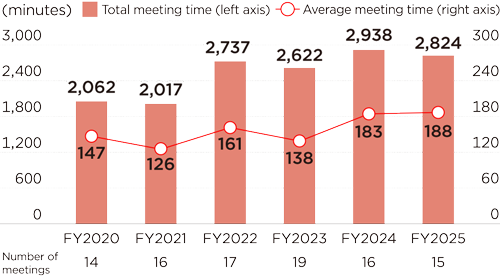
- * The period of the calculations was from March of the year to February of the following year
(2) Matters for deliberation
The Board of Directors deliberates on a wide range of matters, with the major topics and themes as follows (examples provided are not exhaustive).
| Major matters for deliberation | Examples of major themes discussed in FY2025 |
|---|---|
|
1. Matters determined by laws and regulations, including the Companies Act
|
|
|
2. Matters determined by the Corporate Governance Code
|
|
| Important topics for FY2025 | |
| I. Thorough monitoring in the final year of the medium-term management plan |
|
| II. Formulation of new strategies (plans) under the new system and the establishment of a monitoring system |
|
| III. Redefining the role of 7&i (the holding company) and its board of directors, based on the above I and II |
|
8. Evaluation of the Board of Directors' effectiveness [CGC Supplementary Principle 4.11.3]Updated
(1) Fundamental approach to evaluation of the Board of Directors' effectiveness
The Company believes that it is important for the Board of Directors to function effectively in order to improve corporate governance and maximize corporate value. For this reason, the Company implements an important PDCA cycle in which it evaluates the effectiveness of the Board of Directors ("Board of Directors' evaluation ") every year through objective analysis and thorough discussion, and links the results to concrete actions to further improve the effectiveness of the Board of Directors.
In addition, the Company has established the following policy regarding the Board of Directors' evaluation.
Board of Directors' evaluation implementation policy
- 1. The evaluation shall basically be a "self-evaluation," to be performed each year by all Directors and all Audit & Supervisory Board Members.
- 2. Progress of the important topics set in the previous year's Board of Directors' evaluation shall be confirmed and evaluated.
- 3. With regard to the Board of Directors' evaluation process (conducting surveys and interviews, utilizing third-party organizations, etc.), the Board of Directors will review the necessity of revisions on an annual basis, based on the evaluation of the Board of Directors in the previous fiscal year.
(2) FY2025 Board of Directors' evaluation process
The evaluation process for FY2025 was reviewed by the Board and conducted as follows.
| Evaluators | All directors (13) and Audit & Supervisory Board members (5) |
|---|---|
| Third-party organization | Sumitomo Mitsui Trust Bank, Limited (“the third party”) |
| Scope of evaluation | Board of Directors, Nomination Committee, Compensation Committee, Audit & Supervisory Board, and individual directors |
| Evaluation process |
|
| Outline of survey |
|
(3) Results of Board of Directors' evaluation
Results of the FY2025 Board of Directors’ evaluation, as resolved at the Board meeting held on April 16, 2026, as well as important topics for the Board in FY2026, are as follows.
Summary of evaluation
- The Board of Directors established a Special Committee composed of independent outside directors in response to the acquisition proposal received from Alimentation Couche-Tard Inc. in July 2024. The Special Committee engaged in ongoing deliberations regarding the proposal and related alternatives from the perspective of enhancing shareholder value and corporate value, with its findings reported to the Board of Directors on a timely basis, and the Board itself conducted discussions based on the same perspective. These efforts continued until July 2025, when Couche-Tard terminated its discussions with the Company and withdrew its proposal.
- Against this backdrop, and in order to accelerate the execution of strategic initiatives, the Board of Directors resolved on March 6, 2025 to appoint Mr. Steve Dacus as the next President and Chief Executive Officer. On the same day, through the coordinated efforts of the Board of Directors, the Special Committee, and management, a detailed review aimed at realizing value creation was completed, and "Update on Management Initiatives" was announced, setting forth a concrete plan to significantly enhance shareholder value and corporate value. Subsequently, the CEOs of key operating subsidiaries were also replaced, and the transformation of the Group's structure was steadily advanced, including the deconsolidation of York Holdings Co., Ltd. and Seven Bank, Ltd. in September 2025.
- In fiscal year 2025, the Board of Directors addressed the important agenda items described above, as well as issues identified in the prior year's Board effectiveness evaluation and the priority themes established for fiscal year 2025, and worked on monitoring the management and performance of key operating subsidiaries in line with the "Transformation of 7-Eleven" announced on August 6, 2025, as well as overseeing the progress of transformation initiatives. At the same time, there remains room for improvement in the frequency and pace of deliberations, reporting, and discussions on key issues related to the Group's future growth. In addition, continued discussion is needed regarding the enhancement of the holding company's functions in light of changes in the Group's structure, as well as the role that the Board of Directors should play going forward.
- Each director and Audit & Supervisory Board member has engaged in open and candid discussions, bringing diverse perspectives based on their respective expertise, experience, and capabilities, thereby ensuring the effectiveness of the Board of Directors as a whole. In addition, the Board has appropriately fulfilled its roles and responsibilities, including its monitoring function, through the active utilization of voluntary committees (the Nomination Committee and the Compensation Committee). Going forward, the Company will continue to deepen these efforts in light of changes in the internal and external environment, and will strive to further enhance the effectiveness of the Board of Directors.
Important topics for the Board in FY2026
1. Monitoring progress on each strategy and initiative toward global growth
2. Updating the infrastructure that supports global growth
a. Strengthening global governance and enhancing the verification/assessment of its effectiveness
b. Redefining the role and structure of the Board of Directors
a. Strengthening global governance and enhancing the verification/assessment of its effectiveness
b. Redefining the role and structure of the Board of Directors
In order to ensure the steady promotion and implementation of the important topics for FY2026, we have reflected them in the annual agenda for the Board of Directors, and ensured that the Board of Directors has an opportunity to consider and confirm them. The annual agenda for the Board of Directors is reviewed and revised as necessary from time to time, taking into account the progress and implementation status of the important topics.
Going forward, we will continue to work to improve the effectiveness of the Board of Directors' evaluation, in order to achieve sustainable growth and increase corporate value over the medium to long term.
- *We will also steadily implement the various measures regarding issues raised in the 2025 Board of Directors' evaluation (summary provided below).
〈Examples of issues raised in the FY2025 Board of Directors' evaluation〉
1. Role and Composition of the Board of Directors
- Need to strengthen the monitoring function as the Board of Directors of a holding company.
- Need to foster a common understanding of the roles of the Board of Directors, Outside Directors, the division of roles between execution and supervision, and the roles of Audit & Supervisory Board Members.
2. Initiatives to Improve the Efficiency of Deliberations
- Need for further improvement in explanation materials for proposals, such as clarifying the points to be discussed.
3. Selection of Agenda Items
- Need for further strengthening in areas such as the verification of the status of internal controls.