
- Top
- Investor Relations
- IR Library
- Management Report (Integrated Report)
- Message from the CFO
Message from the CFO
Achieving the goals of our transformation plan and fulfilling every promise made to our stakeholders
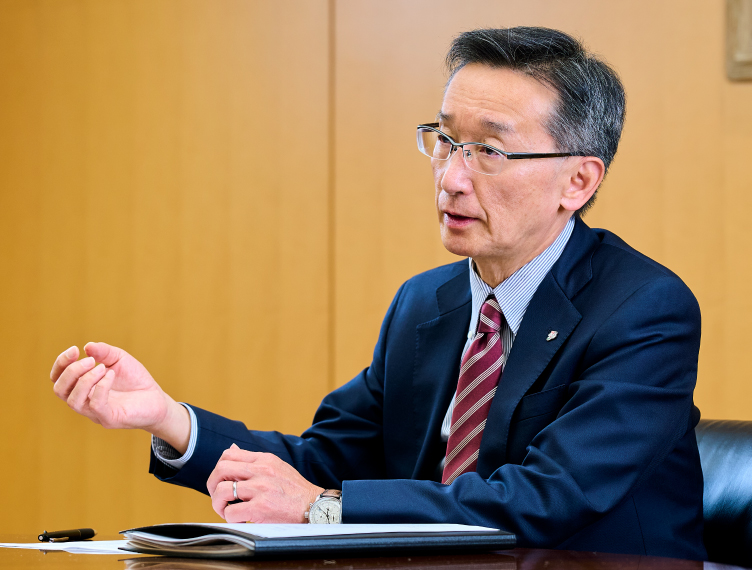
Yoshimichi MaruyamaDirector, Managing Executive Officer & CFO
Introduction: Commitment to transformation
In September 2025, the Seven & i Group transitioned to a structure focused exclusively on the CVS business and began advancing various transformation initiatives aimed at further growth in the global market. As CFO, at this major turning point for the Group, I would like to share my perspective on our current challenges and my commitment to sustainably enhancing corporate value.
We are keenly aware that our current corporate and shareholder value, as reflected in our stock price, do not fully represent our true capabilities. This indicates that there is room to further strengthen market expectations for future growth. Building upon the lessons we have taken from past shortfalls in achieving our plans, we will make enhancing shareholder value our top priority and make every effort to achieve this end.
Harnessing our past experiences and lessons learned as the driving force for our next phase of growth, we will deliver our transformation plan and steadily fulfill the commitments made to our stakeholders.
Rebuilding Seven & i’s structure as a CVS business group
This past year has been one of significant changes for the Company. Following the recommendations of the Strategy Committee in April 2024, we have implemented initiatives to maximize corporate and shareholder value for the Group, significantly transforming our structure. Furthermore, since the launch of the new management structure in May 2025, we have established a more effective governance system and announced our roadmap through 2030 in the “Transformation of 7-Eleven” document.
The most significant aspect of this transformation plan is that Seven & i Holdings now specializes in the CVS business. This marks a departure from our previous structure, under which management was conducted separately for each business, each facing distinct operational challenges. Under the new structure, the Company has shifted toward operations centered on a unified 7-Eleven framework. As a result, our management strategy has become clearer, and we are now aligned as a single business entity, prioritizing the allocation of management resources to achieve Groupwide objectives. This represents a significant shift from our previous approach to both business and financial operations, and we believe it will strengthen organizational unity, improve efficiency and accelerate the Company’s growth.
With respect to the speed and direction of these transformations, we are receiving earnest opinions from stakeholders. “The direction is clear. Now, it's time to deliver results.” We are taking concrete actions to deliver those results. While we have earned a degree of trust, we recognize that we are only halfway there. To solidify this trust, we believe it is essential to steadily fulfill the commitments that we have made and demonstrate our progress through tangible results. We understand that our ability to execute is being tested now more than ever, and we will continue to meet this challenge by diligently executing our plans and delivering results.
Enhancing shareholder value with ROIC as a core metric
As mentioned at the beginning of this message, enhancing shareholder value is our top priority. We believe the primary reason our shareholder value has been slow to improve is low capital efficiency. While quantitative growth, such as EBITDA growth, has been solid to date, improving capital efficiency, particularly at SEI, is an urgent priority.
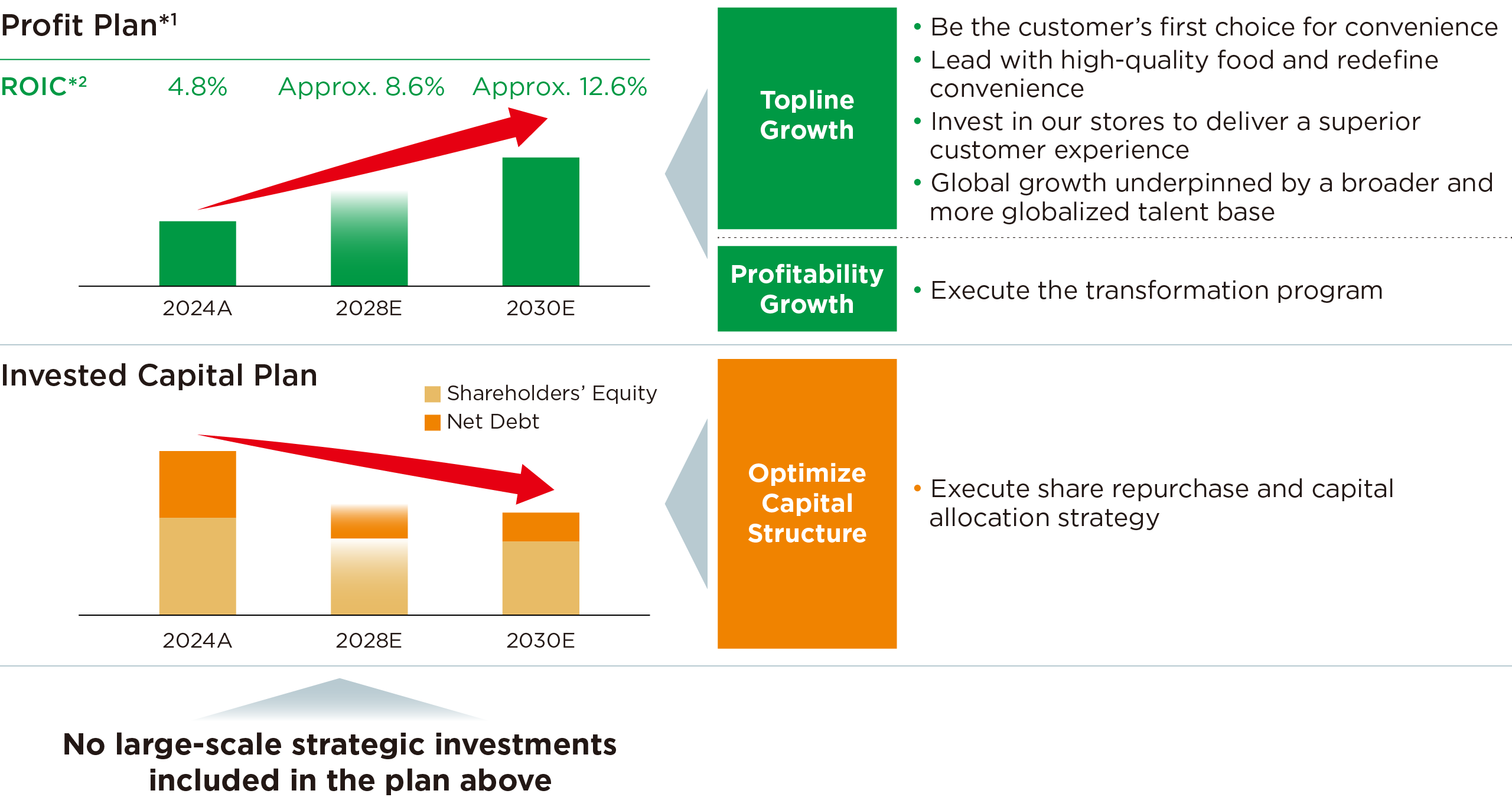
We are determined to change this situation. We will make ROIC a core KPI and raise it to a level comparable to global peer CVS companies–specifically, 8.6% in FY2028 and 12.6% in FY2030. To improve ROIC, we must manage both the numerator and denominator of this metric: growing profits while optimizing invested capital.
Furthermore, we are preparing for the adoption of IFRS, with implementation starting in FY2028. This will enable stakeholders to compare the Company with global peers on a consistent basis. For example, transitioning from Japanese GAAP to IFRS will eliminate the amortization of goodwill exceeding ¥130 billion based on FY2024 results, boosting profits and increasing EBITDA by several hundred billion yen.
Regarding profit growth, it is essential to deliver results through a customer-centric growth strategy and disciplined execution. Through reflection on our past performance, we have recognized that our sustained growth has led to a weakening of our proactive stance—particularly in anticipating changes to customer behavior and exceeding their expectations. We believe this is a shared challenge in both Japan and the United States.
At SEJ, we tended to believe that if we kept creating high-quality products, customers would naturally purchase them. However, we received feedback criticizing our prices and merchandise variety. We will confront these concerns head-on, strengthen two-way communication with customers, and shift toward an approach focused on developing and delivering merchandise and services that anticipate customer needs. This will help restore robust store growth across our operating regions. Specifically, to address the lack of differentiated merchandise, we are reviewing our merchandise development value chain. In the past, the Merchandising Division led development, while the Operations Division deployed merchandise to stores. Going forward, we need a mechanism to incorporate insights gained through direct customer engagement into merchandise development. To achieve this, we will pursue co-creation marketing that involves not only the Merchandising Division, but also operations, marketing, and communications, creating new value and communicating that value more effectively to customers.
At SEI, amid a challenging economic environment, we are advancing a food-centric strategy to attract customers to our stores. This complements our value-focused initiatives, including the development of merchandise and services tailored to the needs of our core customer base: low- and middle-income earners. At the same time, we are working to strengthen the Japanese food value chain while leveraging the strengths of the Group. Food is an area where regional cultures have a strong influence. Here, we will pursue more rigorously than ever the development of products that earn the support of local customers. In addition, in our fuel business, we will enhance profitability through vertical integration, capturing revenue opportunities across the entire value chain—from refineries to retail stores—including procurement and transportation.
Regarding the optimization of invested capital, we will address this through measures aligned with the capital allocation framework announced in August 2025, as outlined below.
- *1Net income + Interest expense x (1 - Effective tax rate)
- *2Based on current J-GAAP
Financial strategy for necessary major investments ahead
Our fundamental policy is to achieve accelerated growth, enhanced shareholder returns and a strengthened financial position in a balanced manner through disciplined capital allocation.
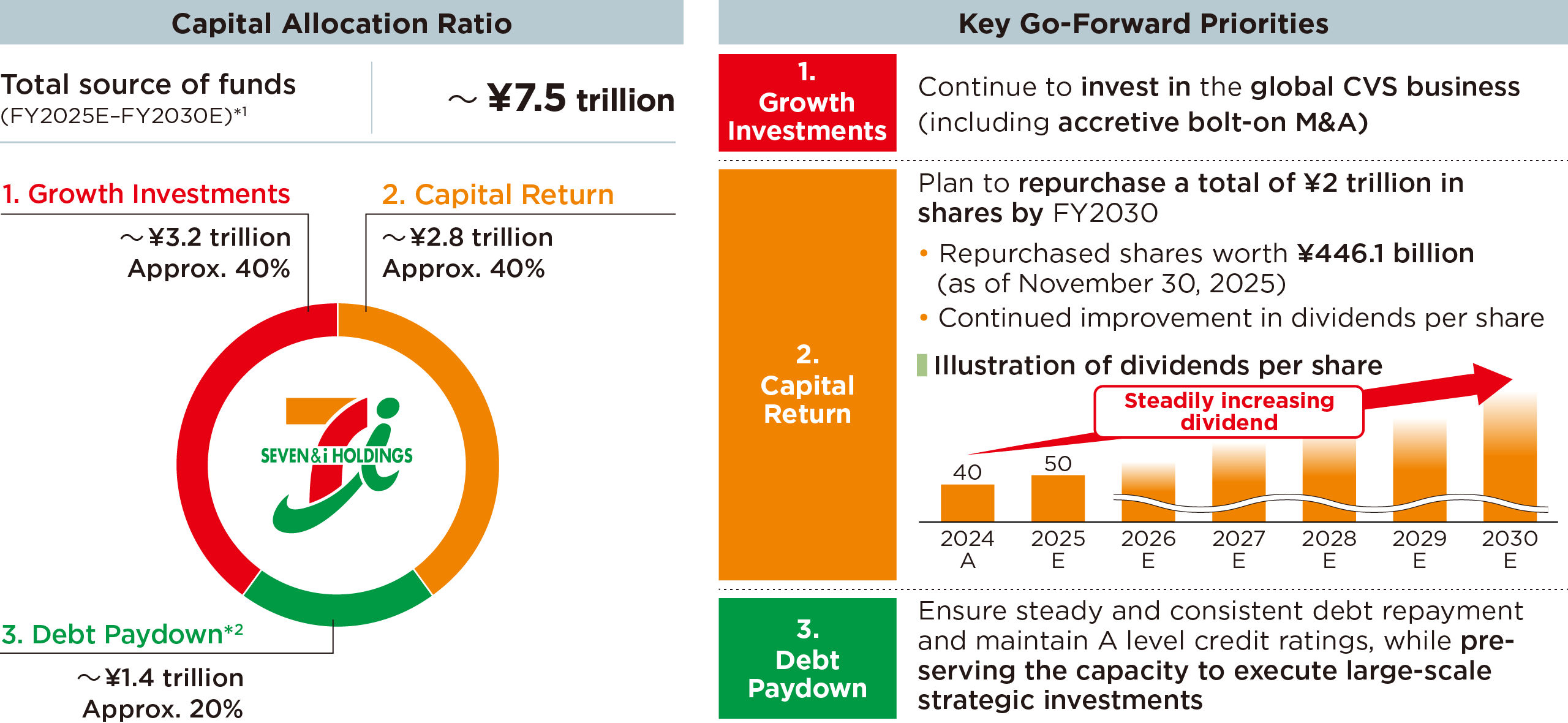
For the period from FY2025 to FY2030, we plan to generate approximately ¥7.5 trillion through a combination of operating cash flow from business growth and capital recovery. We will allocate roughly 40% of these funds each to growth investments and capital returns, with the remaining 20% directed toward debt paydown and other purposes.
Regarding growth investments, we will continue to focus capital expenditures on our global CVS business, allocating ¥3.2 trillion by 2030. This investment includes opportunities for small-scale bolt-on M&A, but the majority will be directed to initiatives for organic growth.
When evaluating investment opportunities, we will apply stricter investment criteria to improve capital efficiency. Previously, our hurdle rates were set at the consolidated level. However, effective investment discipline requires benchmarks that reflect regional risks and economic conditions. Accordingly, we will establish regional hurdle rates going forward to support growth across the Group. As a holding company, we will assess whether investment proposals submitted by each operating company meet these benchmarks. Proposals that meet our criteria will be prioritized under a unified 7-Eleven strategy, while execution discretion will be expanded at the operating company level to allow them greater freedom. For approved investments, the holding company will closely monitor progress and execution, and maintain disciplined governance.
Regarding shareholder returns, we announced in March 2025 our plan to conduct repurchase totaling approximately ¥2 trillion by FY2030. This is a highly significant initiative, representing the cancellation of approximately one-third of our outstanding shares. However, our current stock price suggests that the market has not yet fully recognized its impact. Therefore, we will continue to execute this plan steadily, including the ongoing ¥600 billion repurchase, while further strengthening our efforts to communicate the significance of this initiative to the market.
Furthermore, among the KPIs outlined in our roadmap toward 2030 (see p. 29), our Debt/EBITDA ratio of 0.6 times for FY2030 assumes normal business operations and is not a target in itself. Rather, we want our stakeholders to understand that this level reflects our commitment to prepare for the next phase of growth by maintaining the financial capacity and flexibility to support future growth, including the ability to execute large-scale strategic investments when appropriate, while maintaining strict financial discipline. The disclosed plan does not incorporate large-scale strategic investments. We will therefore continue to secure a strong financial foundation and establish a framework that allows us to implement measures to improve capital efficiency at the appropriate time.
While this capital allocation plan may be viewed as ambitious by external observers, we are confident that there remains further room for growth, particularly as it does not incorporate large-scale strategic investments. We believe the most important priority is to deliver results steadily and, in doing so, strengthen our credibility.
- *1Includes operating cash flow, proceeds from the deconsolidation of the superstore business segment and IPO of SEI
- *2Includes dividends to SEI’s minority shareholders
Fostering a corporate culture of taking on challenges
We believe the most important element of our plan is the transformation of our corporate culture. We will move away from a traditional model of goal achievement driven primarily by top-down directives, which relied on strong central control, toward a culture in which each individual takes ownership, thinking independently about what role they should play to achieve our 2030 targets. Through this shift, we aim to foster an environment where employees can think creatively and innovate. SEJ President Tomohiro Akutsu has called for the establishment of an “Error & Learn” culture, where employees learn quickly from mistakes and apply those lessons to future efforts. This approach is aligned with our founding philosophy, and with the emphasis placed by CEO Stephen Hayes Dacus across the Group on maintaining a spirit of humility and aggressiveness.
To transform our corporate culture, it is crucial not only to cultivate talent internally, but also to actively bring external talent into the Group. As we pursue our goal of becoming a global retail company, we recognize that we currently lack sufficient talent fully aligned with that ambition. Given the need for swift transformation, it is essential that we recruit outstanding talent from outside the organization. To this end, we will strengthen our recruitment efforts, including hiring individuals from different industries and from outside Japan.
In addition, we will integrate the specialized knowledge and expertise in technology, supply chain development, and talent development drawn from our diverse global workforce into an integrated Center of Excellence built on a unified 7-Eleven philosophy. This will allow us to better leverage these capabilities across regions. Through these initiatives, we will advance the integration of previously fragmented regional systems and strengthen global procurement with key suppliers.
To enable diverse talent to thrive in the global marketplace, we must also significantly transform our talent assignment and compensation systems. In particular, compensation frameworks currently differ between SEI in the United States and SEJ in Japan. While achieving complete uniformity is difficult given regional differences, at a minimum we must align our fundamental approach to compensation in order to support talent mobility. For example, for employees transferring to the United States, where the cost of living is high, it is necessary to introduce a flexible system that maintains compensation at a level that is comparable in real terms to what they received while working in Japan.
Meanwhile, as part of our management culture transformation, CEO Dacus himself has significantly changed the way how communication takes place within the decision-making process. As a general rule, within the holding company, meetings with internal directors are held daily, and weekly one-on-one meetings are conducted with the heads of operating companies. Additionally, we have begun holding monthly business review meetings between the operating companies and the holding company's management team.
By significantly increasing the frequency of these interactions, we have been able to share in greater depth the progress of plans, challenges, and our competitive positioning. As a result, issues are identified and shared earlier, improving both the speed and effectiveness of our responses. For example, through dialogue, it became clear that the challenges faced by SEI and SEJ share more structural similarities than previously anticipated. With this understanding, we initiated discussions from the perspective of what is best for the Group as a whole. By increasing the frequency and depth of communication in this way, and by driving the management PDCA cycle forward, we aim to achieve results more quickly.
Continuously leveraging issues raised as opportunities for management
We view engagement with our shareholders and investors as a key initiative in enhancing shareholder and corporate value. In FY2024, we held individual meetings with 475 companies in Japan and overseas, and further strengthened our engagement through IR Days and overseas roadshows. Feedback received from investors is promptly shared with the Board of Directors and operating companies and is reflected in actions to strengthen our strategy and disclosure practices. In fact, many of our strategic initiatives are direct responses to issues raised by investors, and we believe that deepening mutual understanding through dialogue is essential.
Going forward, we will further strengthen our investor and shareholder relations (IR/SR) activities to accurately identify the highest-priority issues they expect us to address and incorporate these into our plans and strategies. In addition, as discussed earlier in relation to the Debt/EBITDA ratio, we will continue to communicate clearly and consistently through a range of channels to ensure that our intentions are widely understood.
In conclusion
We recognize that this large-scale transformation will not be an easy journey. However, by returning to our founder's spirit of “trust and sincerity” and “responding to change,” we will actively drive transformation with humility and aggressiveness, delivering tangible results step by step. We believe this journey reflects our sincerity and will earn the trust of all our stakeholders. We will pursue this transformation with strong resolve and dedicate our full efforts to creating new value for the future.