

We trace the life and legacy of Toshifumi Suzuki, who remained committed to “Responding to Change while Strengthening Fundamentals,” fearlessly taking on new challenges and driving countless innovations.

Overcoming His Weaknesses
Toshifumi Suzuki was born in 1932 into a family of landowners in Sakaki, Hanishina District, Nagano Prefecture, whose lineage stretched back 15 generations. His mother, Hisami, not only managed the household but was also actively involved in community organizations such as the local women’s association. She held strong views on education and even gave radio talks on child-rearing. His father, Jinshiro, served as mayor of Sakaki and as head of the local agricultural cooperative. Suzuki thus grew up in a home regularly visited by prominent local figures and politicians.
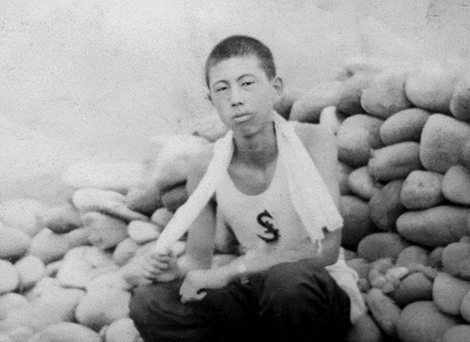 Joined the track and field club to overcome his weakness.
After struggling with a simple oral test during the entrance exam for Ueda Middle School (now Ueda High School), Suzuki realized that he was uncomfortable speaking in front of others.
The following year, he enrolled at Chiisagata Sericulture School (now Ueda Higashi High School) and joined the debate club to overcome this weakness. He also joined the track and field club to address another insecurity: despite being tall, he was a slow runner.
Whenever Suzuki recognized a weakness, he challenged himself to overcome it. This attitude remained unchanged throughout his life.
Joining Tokyo Shuppan Hanbai
After graduating from the Faculty of Economics at Chuo University, Suzuki joined Tokyo Shuppan Hanbai (now TOHAN) in 1956. He was assigned to the newly established Publishing Research Division, where he spent three years studying statistics and psychology, as well as methods for collecting and analyzing data. Suzuki later described these years as his “unofficial graduate school.” The perspectives he gained in statistics and psychology would go on to become the two pillars of Suzuki’s distinctive management philosophy.
Suzuki was subsequently transferred to the Public Relations Department, where his main responsibility was editing Shinkan News, a catalog of new publications distributed free of charge at bookstores. Its initial circulation was around 5,000 copies, but Suzuki desired it to reach a wider audience. Those around him saw little point in increasing the circulation of a publication that was given away for free. Suzuki therefore proposed transforming it into a paid information magazine: making it smaller and easier to carry, while adding casual reading material and other content that would make it worth buying. His supervisors and senior executives initially dismissed the idea based on their professional experience. But when word of the proposal reached the company president, Suzuki was given the opportunity to present it to the board. The president eventually relented, telling Suzuki, “If you feel that strongly about it, let’s give it a try,” paving the way for his idea to become a reality.
Suzuki went on to introduce features designed to capture readers’ interest, including conversations between leading writers of the day, such as Junichiro Tanizaki, and popular actors. By 1962, circulation had grown to 130,000 copies. As Suzuki saw it, when times are dramatically changing, businesses must continually rethink how they view the market. Even seasoned professionals can be left behind if they rely too heavily on past experience. A newcomer’s perspective, free from preconceptions, can sometimes prove more valuable. This belief in valuing fresh perspectives was one Suzuki maintained throughout his life.
〜Encounters with Ito-Yokado and 7-Eleven〜
Encounter with Yokado
Through his work on Shinkan News, Suzuki met prominent writers and up-and-coming journalists. Inspired by these encounters and driven by a desire to accomplish something himself, he became involved in launching an independent production company that produced television programs and other content.
It was while seeking sponsors for the new company that he encountered Yokado (now Ito-Yokado). At the time, Yokado was an emerging supermarket chain that had just begun expanding its store network. After being recruited by one of its employees, Suzuki joined the company in September 1963, despite strong opposition from those around him.
As Yokado grew rapidly, establishing the organizational structure needed to support its expansion became an urgent priority. Suzuki became extensively involved in building its administrative functions, including sales promotion and human resources. He took the lead on initiatives ranging from recruiting new employees at high schools across Japan to developing systems for employee training, performance evaluations, and holidays. At the same time, he introduced new initiatives to raise the company’s profile, including sponsoring television programs and signing popular entertainers to exclusive contracts. By the late 1960s, the strong consumer demand fueled by postwar shortages had begun to subside.
Suzuki was quick to recognize this shift. In the January 1969 issue of Yokado’s internal newsletter, he called on employees, in his capacity as general manager of human resources, to “embrace change with a positive, proactive mindset.”
He wrote on the changing consumer market, “We have moved on from an era when products would sell simply because they were made, or simply because they were available, to one in which they will not sell unless we offer a merchandise assortment that satisfies our customers.” At the same time, he urged employees to “master the fundamentals before seeking to improve the status quo.” These words already reflected the thinking behind “Responding to Change while Strengthening Fundamentals,” which would later become the slogan of the IY Group’s Management Policy Presentation.
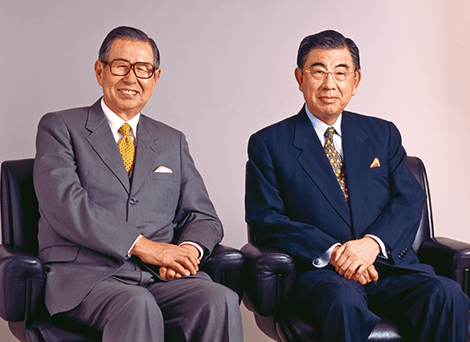 Masatoshi Ito and Toshifumi Suzuki (right).
When Ito-Yokado was listed on the Second Section of the Tokyo Stock Exchange in 1972, the company also ran a series of advertisements in the Nihon Keizai Shimbun titled “Challenges Facing Major Retail Chains.” The series offered a candid look at the current state of major retail chains such as Ito-Yokado and the challenges they faced. Suzuki personally worked with the creative team, discussing and refining the content. Going beyond conventional corporate advertising focused on brand image, the campaign clearly communicated the company’s own views. This unconventional approach attracted widespread attention.

“Responding to Change while Strengthening Fundamentals”
“Responding to Change while Strengthening Fundamentals” was introduced in 1983 as a slogan for the Management Policy Presentations and remains the Group’s main slogan today.
It called for a concrete approach to better understanding customer needs through the repeated process of Tanpin Kanri (Item-by-Item Management): order placement based on hypotheses, followed by verification against actual sales results.
In a buyer’s market, where consumers choose among individual products, this cycle of Tanpin Kanri (Item-by-Item Management) was an important means of understanding market trends and securing profits by reducing markdown losses, write-offs, and opportunity loss caused by products being out of stock. In this sense, it was an extremely practical guiding principle at the heart of Suzuki’s management philosophy.
Encounter with 7-Eleven
As the 1970s began, general merchandise stores entered a major period of transition. One factor was the growing friction between large retailers and local small- and medium-sized retailers over the opening of new large-scale stores across Japan. In 1974, the Large-Scale Retail Stores Law, commonly known as the Large-Store Law, came into effect. It imposed strict restrictions on new large-store openings and required consultation with local retailers and consumers.
Ito-Yokado also encountered opposition from local retailers when presenting plans for new stores, and Suzuki attended these discussions on numerous occasions. He repeatedly heard the argument that the expansion of large stores was hurting smaller retailers. Suzuki, however, maintained that even small and medium-sized retailers could improve their performance by offering products customers wanted, raising productivity, and operating more efficiently.
In the early 1970s, Suzuki traveled to the United States to negotiate the introduction of Denny’s, an American coffee-shop restaurant chain, to Japan. During the trip, he came across 7-Eleven, a chain of small retail stores. He looked into the performance of the Southland Corporation (now 7-Eleven, Inc.), which operated the chain that had begun as an ice retailer in 1927, and found that the business continued to grow.
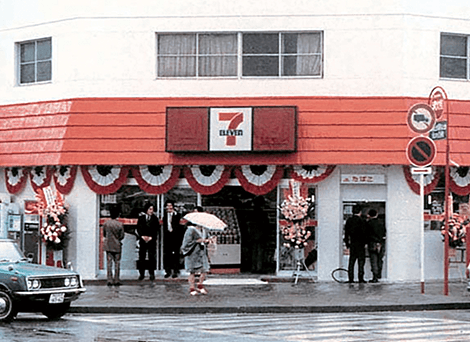
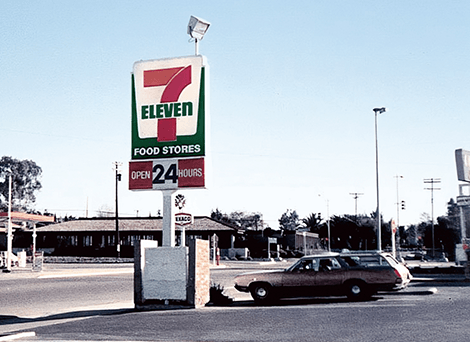 A 7-Eleven store in the United States in the 1970s.
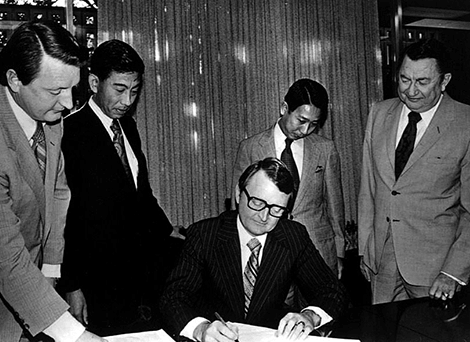 Signing the licensing agreement with the Southland Corporation in the United States.
Suzuki became convinced that “there must be a unique system behind its success that allows small stores to operate efficiently.” He decided to bring 7-Eleven to Japan. The idea met with fierce opposition both within Ito-Yokado and from outside distribution and retail experts. Internally, critics argued that Suzuki, with no firsthand retail experience, could not possibly make the business work, and that the risks of failure with a new retail format were too great. Outside distribution and retail experts were equally skeptical, arguing that it was too early to introduce convenience stores (CVS) to Japan. Suzuki, however, was convinced that “7-Eleven’s success must be supported by systems that improve labor productivity and enhance the value of merchandise development. If we can use those systems to raise productivity at small stores, large and small retailers can coexist and prosper.” Looking back, he recalled, “That is why I was not particularly concerned by the opposition to bringing 7-Eleven to Japan.” Opposition in Japan was not the only obstacle. The Southland Corporation, which held the licensing rights to 7-Eleven, had no interest in entering the Japanese market. It took Suzuki more than a year to persuade the company to open the door to discussions, and formal partnership negotiations finally began in 1973. Southland, however, presented a number of stringent terms, none of which Suzuki considered acceptable. Before the final negotiations, he consulted Masatoshi Ito, then president of Ito-Yokado. Suzuki sensed that Ito was “about 70% against” accepting the proposed terms. With that in mind, Suzuki went into the final negotiations prepared to walk away from the partnership. Ironically, this put him in a strong negotiating position since he could stand his ground without feeling compelled to make concessions. In July 1973, Ito-Yokado and the Southland Corporation reached a basic agreement largely on Suzuki’s terms.
Opening the First 7-Eleven Store
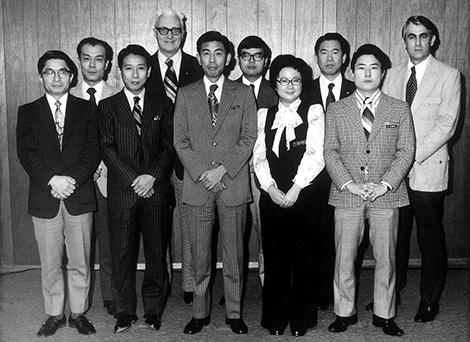 Starting out as a “team of newcomers.”
In November 1973, York Seven (now Seven-Eleven Japan) was established to develop the 7-Eleven business in Japan, with Masatoshi Ito appointed president and representative director and Suzuki executive vice president. Most of its employees were newcomers to the field with no previous retail experience.
Starting out as a “team of newcomers.”
Suzuki was also determined to minimize the new company’s financial dependence on its parent company. At the time of its founding, he told his colleagues, “Let’s make this company go public in the shortest time possible.”
True to his word, the company was listed on the Second Section of the Tokyo Stock Exchange in October 1979 and moved to the First Section in 1981. Both milestones were achieved in record time.
In developing the 7-Eleven business, Suzuki established “Modernization and Revitalization of Existing Small- and Medium-Sized Stores” and “Co-Existence and Co-Prosperity” as its guiding principles. From the very first store, he remained committed to the franchise model. Finding a suitable operator for that first store proved challenging, and although some within York Seven suggested beginning with a corporate store, Suzuki refused to compromise on this principle.
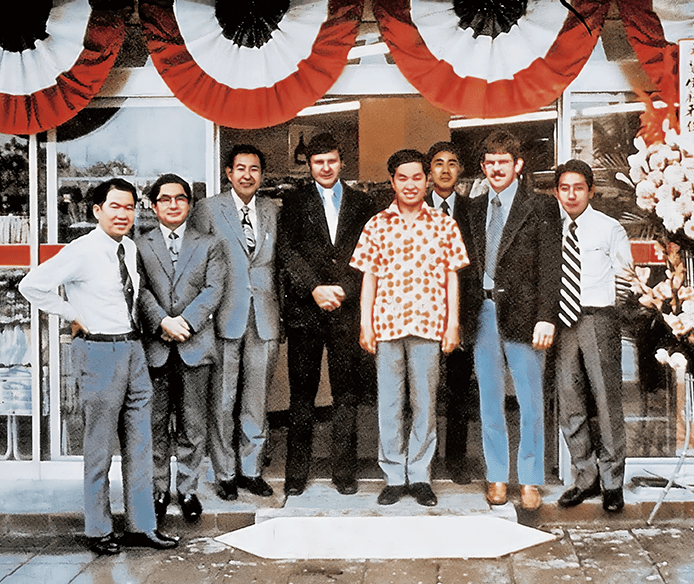
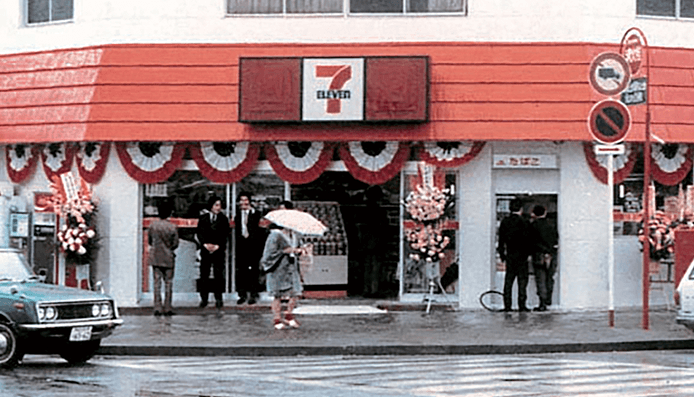
Amid the ongoing discussions, the company received a letter from a young man who had read a newspaper article about 7-Eleven and wanted to open a store. The letter came from Kenji Yamamoto, who ran a liquor store. While considering the future of his business, Yamamoto learned about the launch of 7-Eleven in Japan and felt a sudden “flash of inspiration.” It was decided that Yamamoto would operate the first store, and in May 1974, the 7-Eleven Toyosu store opened in Koto Ward, Tokyo. Suzuki later said, “If Mr. Yamamoto, at just 24 years old, had not willingly taken the initiative to join the 7-Eleven business, the 7-Eleven we know today would not exist.”
For Suzuki, beginning with a franchise store was that fundamental to the very foundation of the business.
Building a System Suited to the Japanese Market
Even after undergoing 7-Eleven training in the United States and studying its extensive manuals, Suzuki and his team could find no “secret” that would help revitalize small- and medium-sized retailers in Japan. After discussions with senior management, they resolved to build virtually every aspect of the system themselves, apart from the accounting system. In a short period of time, they had to develop everything from the franchise agreement to merchandise procurement and logistics.
Once the stores began operating, further challenges emerged. Under the existing distribution system, deliveries arrived in quantities that were too large, quickly filling up store backrooms.
At the time, products were delivered separately by each manufacturer. To address the problem, Suzuki and his team proposed smaller-lot deliveries, which reduced the quantity of merchandise delivered at one time, as well as combined distribution, in which products from different manufacturers were loaded together to consolidate deliveries into fewer vehicles.
The proposals met with strong resistance from manufacturers. Suzuki nevertheless continued to argue that the market was shifting from a “seller’s market” to a “buyer’s market,” and that unless the distribution system was also rebuilt from the perspective of stores (the point closest to the consumer), it would result in ever greater waste. Through repeated discussions with manufacturers, backed by trials conducted at stores, Suzuki and his team eventually succeeded in introducing an unprecedented combined distribution system in 1980, under which milk from multiple manufacturers was delivered together. 7-Eleven subsequently expanded combined distribution to additional product categories and, from an early stage, established its own logistics system, including distribution by temperature range. In doing so, it created a new model for product distribution.

In June 1976, a party was held to celebrate 7-Eleven reaching the milestone of 100 stores. Suzuki later recalled that as he stood to address the franchise owners and their families gathered before him, he was overcome with emotion and tears rolled down his cheeks.
Perhaps it felt miraculous that he and his colleagues, all newcomers to the retail business, had overcome one challenge after another to reach 100 stores. Suzuki later reflected, “It was precisely because we were a team of newcomers that we were free from preconceptions and conventional thinking and able to focus entirely on our customers and franchisees, taking whatever steps were necessary to respond to their needs. That was the only time in my career that I ever shed tears over my work.”
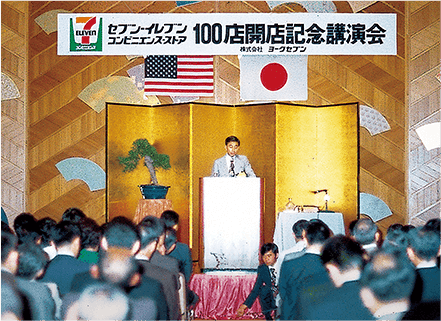
Developing Merchandise Catered to Japanese Consumers
To make customers truly feel that 7-Eleven was a “convenient store,” Suzuki devoted particular attention to its merchandise assortment. He asked, “What kind of Japanese fast food would better meet our customers’ everyday needs?” The answer included products such as onigiri rice balls and oden.
Initially, the idea met with fierce opposition. “Why would customers go out of their way to buy onigiri when anyone can make them at home?” But Suzuki believed that precisely because onigiri was so familiar to everyone, there was significant potential demand. Despite the opposition, he pushed ahead with its development in 1976.
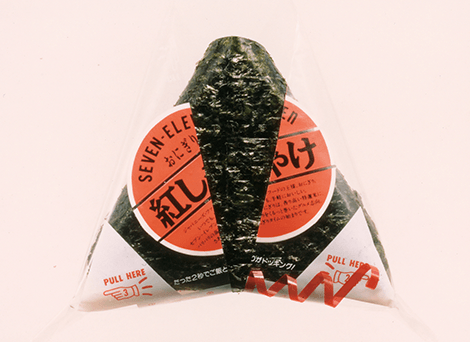 Hand-rolled onigiri.
In developing the merchandise, Suzuki pursued taste and quality relentlessly, seeking to convince customers that it was both tastier and more convenient than making onigiri at home. In 1978, 7-Eleven’s independently developed hand-rolled onigiri became a major hit, laying the foundation for onigiri to become a staple product at convenience stores across Japan.
The Japan Delica Foods Cooperative played a major role in addressing the challenges involved in the development and production of these original Rice and other Delicatessen products, including the joint purchasing of ingredients, quality improvements, and modernization of production processes. Established in 1979, the cooperative brought together high-quality small and medium-sized food manufacturers from across Japan.
Working with this new organization, 7-Eleven continued to focus on developing original products. Suzuki consistently sought to uncover potential demand that no one else had yet identified and to pursue “absolute quality”—quality that satisfied customers in its own right, rather than simply being “better than the competition.”
Tanpin Kanri (Item-by-Item Management) and the Introduction of POS
Suzuki firmly believed that “a retailer’s greatest means of demonstrating the appeal of its store is its merchandise assortment. This is achieved through each individual store’s order placement. Order placement is the most important right each store has.” He therefore placed great importance on tracking sales trends for each individual product to accurately assess customer needs.
When buying chocolate in a “buyer’s market,” customers choose among individual products to find the exact chocolate they want. It was therefore essential to consider products on an item-by-item basis. Suzuki called this idea “Tanpin Kanri (Item-by-Item Management).” He stressed that it should be used not only to reduce losses from unsold products, but also to identify “opportunity loss” (missed sales opportunities stemming from products being out of stock).
As customer traffic and sales increased, however, it became increasingly difficult to track product trends manually. Identifying opportunity loss caused by out-of-stock products was particularly challenging. Suzuki therefore turned his attention to POS (Point of Sale) systems.
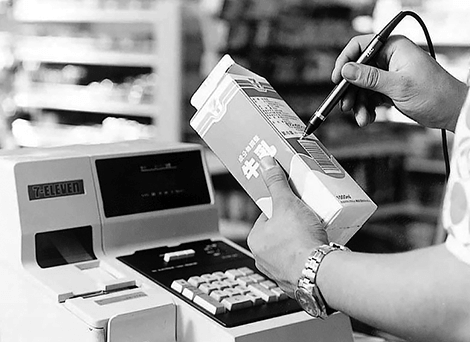 First-generation POS register (pen scanner).
At the time, using POS to test and verify hypotheses was unheard of anywhere in the world. POS was generally regarded merely as a convenient system that could automatically identify best-selling products. Suzuki, however, repeatedly emphasized that POS was a tool for Tanpin Kanri (Item-by-Item Management), one used “to base merchandise assortment on a hypothesis and then verify that hypothesis.”
As the 1980s began, 7-Eleven rapidly expanded its in-store information systems, including POS. As Suzuki himself put it, “7-Eleven is an information systems business.” Even as these systems expanded, he insisted that 7-Eleven clearly define its own “requirements” for how they would be used in stores, taking the lead in system development to ensure that the technology met the practical needs of frontline operations. In 1983, 7-Eleven completed the rollout of Japan’s first full-scale POS system across all of its stores.

Our True Competitor Is Changing Customer Needs
During the 1980s, as the convenience store business continued to grow in Japan, Suzuki was often asked in media interviews who he considered 7-Eleven’s competitors to be. His answer was always the same: “Our competitors are not other companies. Our true competitor is the ever-changing needs of our customers.”
Launch of “Gyokaku”
(Operational Reforms)
In its August 1981 interim financial results, Ito-Yokado reported a decline in ordinary profit for the first time. The prevailing view within the company was that this was a temporary downturn caused by external factors, such as the effects of the second oil crisis and unfavorable weather.
Suzuki analyzed the situation differently. The era of rapid economic growth, when general merchandise stores had enjoyed dramatic expansion, was over. With the consumer market shifting from a “seller’s market” to a “buyer’s market,” he believed the most important task was to understand where customer needs lay. Moreover, because those needs were constantly changing, relying on past patterns would not keep pace. It was essential to constantly identify changes as they happened.
Suzuki therefore instructed the company to urgently reassess its policies from scratch and formulate strategies for profit growth. He argued that the company needed measures capable of generating profit growth even if sales fell to zero.
In February 1982, Ito-Yokado implemented a major organizational restructuring and launched the Operational Improvement Project, led by Suzuki. In 1984, this became the Operational Reform Committee. The initiative marked the beginning of Ito-Yokado’s company-wide operational reforms, known internally as “Gyokaku.”
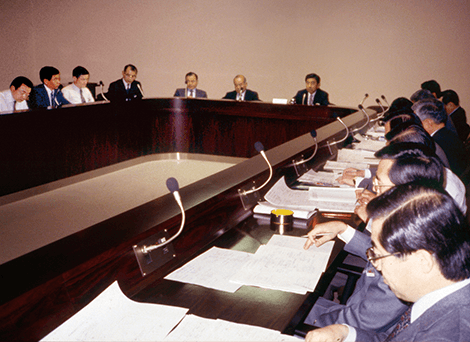 Operational Reform Committee.
The first step was to thoroughly identify Dead Items/Slow Sellers on sales floors in order to reduce the large volumes of inventory held by each store. This challenged the conventional wisdom that retailers needed to maintain ample inventory to do business.
The initiative naturally met with strong resistance, particularly from senior sales executives. Masatoshi Ito, then president of Ito-Yokado, nevertheless endorsed Suzuki’s approach and entrusted him with the project.
The reforms soon produced results. In its 1983 interim financial results, Ito-Yokado reported a 51.8% year-on-year increase in ordinary profit and a 34.4% increase in operating profit, drawing widespread attention for its rapid recovery.
At the heart of the “Gyokaku” operational reforms was Tanpin Kanri (Item-by-Item Management). Through the continuous process of developing and verifying hypotheses, the idea of optimizing merchandise assortment and inventory gradually spread throughout the company.
Business Turnaround in the United States
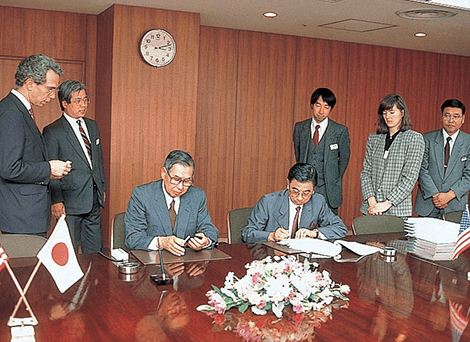 March 1990: Signing the basic agreement to support the turnaround of the Southland Corporation.
Around 1990, major convenience store operators across the United States were experiencing financial difficulties, and the Southland Corporation was no exception. In 1990, the IY Group was asked to provide capital and participate in the company’s management. The following year, Seven-Eleven Japan and Ito-Yokado acquired approximately 70% of Southland’s shares and began working to turn the company around. At the time, it was the largest postwar effort by a Japanese company to restructure a U.S. company.
March 1990: Signing the basic agreement to support the turnaround of the Southland Corporation.
At the time, distribution and retail experts and academics in the United States were claiming that “the age of the convenience store is over.” Suzuki, however, firmly believed the business could recover if it could keep adapting to changing customer needs, and he vigorously defended this position in meetings and discussions.
Previously, each store’s merchandise assortment had largely been determined by the head office. The turnaround began by shifting to merchandise assortment based on each store’s order placement.
This was followed by a series of reforms, including using Tanpin Kanri (Item-by-Item Management) to develop merchandise assortment tailored to customer needs, introducing fresh foods with a strong emphasis on taste and quality, and rebuilding the logistics system. These reforms proved successful, and the company returned to profitability in 1993. In July 2000, it was relisted on the New York Stock Exchange.
Emphasizing Value and Team Merchandising
In 1992, Suzuki succeeded founder Masatoshi Ito as president of Ito-Yokado and representative of the IY Group. In Japan, the collapse of the economic bubble had ushered in a deflationary economy, and the retail industry increasingly viewed the future as an era of price competition and discount stores.
Suzuki, however, continued to argue that what truly mattered was the value of products, and that the discount-store boom was nothing more than a passing trend.
To offer consumers products with the value they wanted at affordable prices, Suzuki spearheaded a merchandise development approach known as “Team MD (Merchandising).” Under this system, sales data gathered on the sales floors of 7-Eleven and Ito-Yokado was shared among specialists in areas including raw material procurement, manufacturing, and processing, allowing them to work together as one team to develop merchandise that met customer needs.
The approach built on expertise accumulated through 7-Eleven’s development of original products and would later provide the foundation for SEVEN PREMIUM.


Before the 1990s, product life cycles tended to be relatively long, following a clear “Mt. Fuji-shaped” pattern: sales would begin to rise, reach a peak as demand concentrated, and then enter a period of decline. In the 1990s, however, this shifted to what Suzuki described as a “tea canister-shaped” pattern, in which a product would suddenly surge in popularity, reach its peak, and then abruptly stop selling. This was followed by a “pencil-shaped” pattern, in which the peak period became extremely short.
The retail industry regarded the phenomenon of product lifecycles and trends shortening as evidence of an “age of diversification.” Suzuki, however, described it as an “age of uniformity,” observing that, at any given moment, everyone wanted the same product. Underlying this view was Suzuki’s belief that it was essential to closely examine what was happening in front of him, down to the smallest detail, and discern the changes taking place beneath the surface.
A New Challenge: Establishing a Bank
In October 1987, 7-Eleven began accepting payments for Tokyo Electric Power Company, Incorporated’s electricity bills and subsequently expanded the service to include other utility bills and insurance premiums. This led to the idea that 7-Eleven stores could offer greater convenience if cash withdrawals were available in-store.
In 1999, Suzuki considered installing bank ATMs in 7-Eleven stores. However, regulatory barriers and the considerable burden this would place on stores made the idea difficult to implement. After exploring alternatives, including establishing a jointly funded operating company with a bank, Suzuki ultimately decided to establish a bank specializing in payment and settlement services.
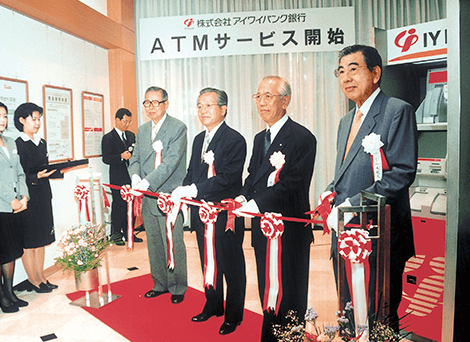 IY Bank (now Seven Bank), which launched ATM services. A ribbon-cutting ceremony was held to mark the launch.
When the plan became public, however, it met with strong concern and opposition from the company’s main bank and other banking experts. From the outside, the move was seen as the IY Group entering the financial services industry. From Suzuki’s perspective, however, the aim was not to enter the financial services business, but to provide payment and settlement services as an extension of the Group’s existing retail services. The new bank therefore proposed a business model centered on ATM fees. Banking experts strongly opposed this approach as well, arguing that it would be impossible to sustain a bank on this source of revenue alone. Suzuki nevertheless refused to abandon the idea. In 2001, approval was finally granted to establish IY Bank (now Seven Bank).
Birth of Seven & i Holdings
By the late 1990s, an imbalance had emerged within the IY Group: the market capitalization of 7-Eleven had surpassed that of its parent company, Ito-Yokado. Resolving this distortion had become an urgent priority to ensure the stable management of both companies.
Immediately after the first morning assembly of 2005 in January, Suzuki presented his solution. He instructed the executives, “We will establish a pure holding company by September. I want you to begin preparations.”
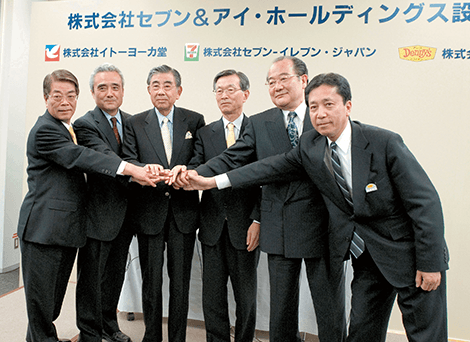 At the press conference announcing the establishment of Seven & i Holdings, The Group announced its aim to create a “New Comprehensive Lifestyle Industry,” with its operating companies working together under the holding company.
The plan was to bring listed companies including Ito-Yokado, Seven-Eleven Japan, and Denny’s Japan under the holding company as operating companies. Completing the preparations in just six months would be a challenging undertaking. Nevertheless, Suzuki believed that swift and decisive structural reform was necessary. He personally took charge of the preparations, and in September 2005, the pure holding company Seven & i Holdings was established as planned.
In 2006, Millennium Retailing (now Sogo & Seibu) became a wholly owned subsidiary, while York-Benimaru, which had previously maintained a business alliance with the Group, also joined. Bringing together retail formats closely connected to everyday life—including convenience stores, general merchandise stores, department stores, and specialty stores—the Group made a fresh start as a unique business organization unlike any other in the world.
SEVEN PREMIUM
At a Group strategy meeting, Zenko Otaka, then president of York-Benimaru, proposed developing a competitive private brand (PB). He believed that by leveraging the Group’s sales strength, it would be possible to create attractive products that could match national brands in quality while remaining affordable and generating a healthy gross profit.
Suzuki embraced the proposal and appointed Otaka to lead product development. He stressed that above all, the products had to deliver quality and value that customers themselves would recognize.
Building on the product development expertise cultivated by 7-Eleven, the Group adopted the Team MD approach, bringing together specialists in areas ranging from raw material procurement to manufacturing and processing. The result was the creation of SEVEN PREMIUM.
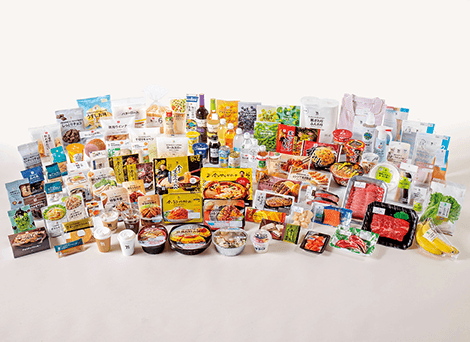 SEVEN PREMIUM, which has grown to approximately 3,500 products as of the end of February 2026.
SEVEN PREMIUM products were developed in partnership with leading manufacturers in each product category, with the name of the manufacturer displayed on the product. At the time, it was unusual for well-known manufacturers to publicly identify themselves as the producers of PB products. This distinctive approach helped SEVEN PREMIUM rapidly gain recognition among customers. At the same time, the policy of selling the same products at the same prices across different retail formats, without discounting them even during sales, generated resistance within the Group.
Suzuki nevertheless remained firmly committed to the policy, believing it was essential to building customer trust in the products. The Group subsequently found ways to strategically tailor SEVEN PREMIUM to its different retail formats. At 7-Eleven, for example, ¥100 frozen foods catered to demand for single-serving portions became a hit. Through such initiatives, SEVEN PREMIUM grew into a major product brand.
SEVEN CAFÉ
In 2013, coffee machines appeared at 7-Eleven counters with the launch of SEVEN CAFÉ, offering coffee for ¥100 a cup. It was the culmination of a long history of challenges dating back to 1980, with four previous attempts involving repeated trial and error.
On its fifth attempt, the Team MD approach finally succeeded in developing a system that delivered the freshly brewed taste and aroma that satisfied customers while minimizing the operational burden on stores.
This 30-year journey embodied principles Suzuki had long advocated: “Don’t imitate others,” and “Don’t settle for relative quality or being better-tasting than others. Pursue absolute quality that truly satisfies customers.”
As of 2026, SEVEN CAFÉ has surpassed nine billion cups in cumulative sales and become one of 7-Eleven’s core products. It demonstrated that even in the 21st century, “pursuing value that cannot be found elsewhere” and “developing products from the customer’s perspective” could create an enormous new market within the retail industry.
The Legacy of Challenge
The greatest value Toshifumi Suzuki’s challenges brought to Japanese society was not simply establishing the convenience store as a new retail format. His greater achievement was transforming it into a form of social infrastructure that supports people’s everyday lives.
7-Eleven grew beyond its role as a retailer of food and daily necessities to provide services essential to everyday life, including utility bill payments, ATM services, access to various government services, and support during disasters. Behind this evolution was Suzuki’s perspective: always viewing changes in society from the customer’s standpoint and continually creating new value.
Initiatives such as combined distribution, Tanpin Kanri (Item-by-Item Management), and the use of POS systems went beyond innovation within a single company and had a major impact on the development of Japan’s distribution and logistics systems. These reforms, born from continually rethinking systems from the consumer’s perspective rather than the seller’s, subsequently spread throughout the retail industry and helped lay the foundations for today’s distribution infrastructure.
Underlying all of this was Suzuki’s unwavering philosophy of “responding to change” and “putting oneself in the customer’s shoes.”
Rather than resting on past successes or accepted industry wisdom, he continued to focus on changing customer needs. Even after stepping away from frontline management in 2016, he continued to offer his insights on the distribution and retail industries through lectures and other activities, dedicating himself to their continued development.
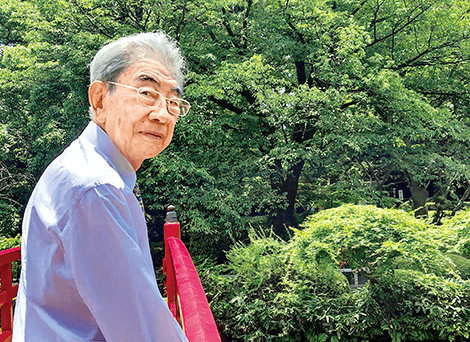 At Hotel New Otani Tokyo, where Suzuki kept his office.
The systems and principles Suzuki established continue to live on within the Group today. Employees, franchise owners, and business partners continue to engage with customers in their respective roles, recognize change, and take on the challenge of creating new value. Suzuki’s journey cannot be understood simply as the achievements of a single business leader. It represents an ongoing history of challenge, passed from one generation to the next. Even in an era of accelerating change, the principles Suzuki championed—“responding to change” and “starting from the customer”—will continue to illuminate the path forward for the Seven & i Group.
Note: Honorifics have been omitted from personal and company names throughout the text.